
Cargando modelo 3D...
Huntington
Mobiliario / Furniture
Marfil / Ivory, Metal / Metalwork, Plata / Silver
Medina Azahara (Córdoba, España)
Desconocido / Unknown
Hispanomusulmán (Califal) / Hispano-Islamic (Omeya Caliphate)
Buena
D752
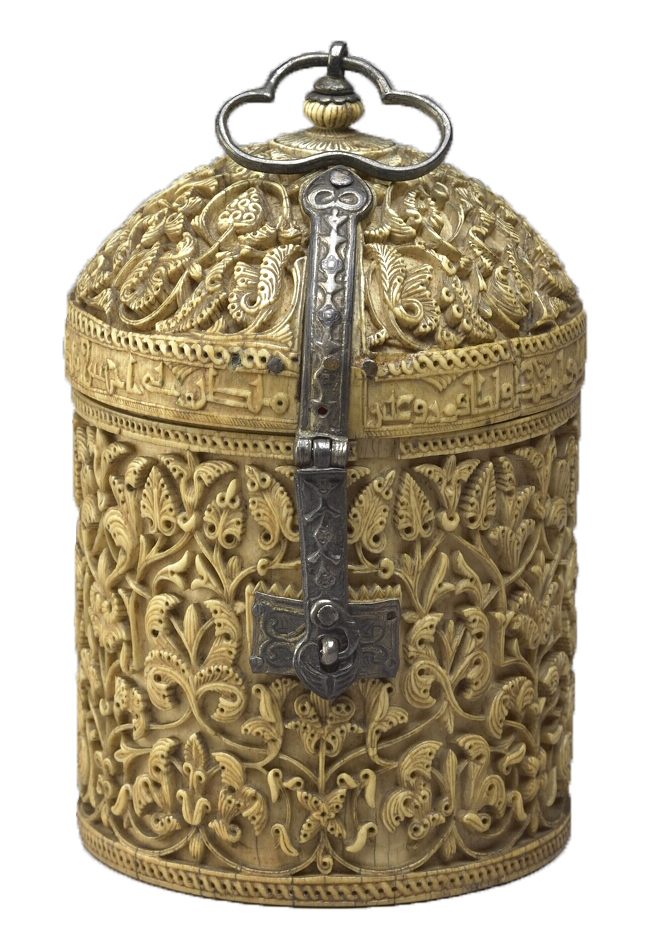
Esta pieza lleva en el interior de la tapa una etiqueta rectangular de papel pegada y enmarcada por dos líneas negras en la que se lee: “On loan from [en letras impresas] John Malcolm 1 Stanhope St. N. 1 [escrito a mano con tinta de color sepia]. Entre las palabras Stanhope y St. está impreso el número 18. La tapa tiene varias grietas y una fractura. Dicha fractura fue pegada con cola y reforzada con dos pequeñas placas de metal y nuevos clavos remachados, a excepción de uno de ellos. Su estado de conservación es muy bueno. Sólo ha perdido dos pequeños fragmentos, uno en el interior del cierre de la tapa y otro en la cenefa superior del bote. Conserva restos de policromía de color verde claro en los contornos de la inscripción cúfica con otros puntos de color verde, así como restos de color rojizo en los contornos de la decoración. Esta píxide había estado previamente en la colección Toussaint-Joseph Bauer, París; John Malcolm of Poltalloch. Fue comprada por Archer M. Huntington a L. Harris, Londres en 1914 por 1837 libras y 10 chelines y donada a la Hispanic Society ese mismo año.
(1870): “Un coffret árabe”, Le Magasin Pittoresque, 38. París: 4-6., Assas y Ereño, M. de (1876): “Programa de la asignatura de arqueología de la Escuela Superior de Diplomática”. Madrid: 113., Beckwith, J. (1960): “Caskets from Cordoba”. The Majesty’s Stationery Office. London: 14-50, lám. 12., Burlington Fine Arts Club (1879): “Catalogue of bronzes and ivories of European origin, exhibited in 1879”. London: 45, 270., Bush, O. (2017): “Poetic Inscriptions and Gift Exchange in the Medieval Islamic World”, Gesta, 56.2, 183, 192-97, fig. 1., Caskel, W. (1936): “Arabic inscripctions in the collection of the Hispanic Society of America”. New York: 35-36, lám. 4., Codding, M. et al. (2004): “The Hispanic Society of America: A Centennial Celebration”. The Hispanic Society of America. New York: 17, 38., Codding, M. (2017): “Tesoros de la Hispanic Society of America: visiones del mundo hispánico”. Museo Nacional del Prado y The Spanic Society of America. Madrid y New York: 100-1, no. 17., Cutler, A. (2005): “Ivory Working in Umayyad Cordoba: Techniques and Implications”, Journal of the David Collection 2, no. 1 y 2, pp. 37-47, figs. 19-27, 322. , Ecker, H. (2004): “Caliphs and Kings: The art and influence of Islamic Spain”. Freer Gallery of Art and Arthur M. Sackler Gallery. Washington: 26-27, 125-126., Ettinghausen, R. and Grabar, O. (1987): “The art and architecture of Islam: 650-1250”. Penguin Books. Harmondsworth: 145-62, fig. 130., Ferrandis, J. (1928): “Marfiles y azabaches españoles”. Barcelona: 69, lám. 9., Ferrandis, J. (1935-40): “Marfiles árabes de Occidente. Vol.I”. Cuerpo Facultativo de Archiveros, Bibliotecarios y Arqueólogos. Madrid: 64-66, lám. 12-13., Gildemeister (1870): pp. 115-127, lám. 1., Gómez-Moreno Martínez, M. (1927): 5, fig. 14., Hillenbrand, R. (2005): “The Syrian Connection: Archaic Elements in Spanish Umayyad Ivories”, en K. von Folsach y J. Meyer (eds.), Hournal of Davis Collection, vol. 2. Copenhagen: 65., Hispanic Society of America (1927): Hispano-Moresque Ivory Box in the Collection of the Hispanic Society of America. New York: 26-29, lám 1., Holod, R. (1992): “Luxury Arts of the Caliphal Period”, en J. Dodds (Ed.), Al-Andalus: The Art of Islamic Spain. Metropolitan Museum of Art. New York: 41-47 y 196, 196., Kühnel, E. (1971): “Die islamischen Elfenbeinskulpturen, VIII-XIII Jahrhundert”. Berlín: 36-37, lám. 13-14., Kunz, G. F. (1916): “Ivory and the elephant in art, in archaeology, and science”. Doubleday, Page and company. New York: 45., Le Bon, G. (1884): p. 601, fig. 324., Leguina y Vidal, E. (1912): “Arquetas hispano-árabes”. Librería de Fernando Fé. Madrid: 49., Lenaghan et al. (eds.) (2000): “The Hispanic Society of America. Tesoros”. The Hispanic Society of America. New York: 126-27, no. 12., Riaño, J. F. (1879): “The industrial arts in Spain”. London: 139., Malcolm, J. (1913): p. 12, nº 18., Migeon, G. (1926): “Les arts musulmans”. G. van Oest. París: lám. 41., Prado-Vilar, F. (1997): “Circular Visions of Fertility and Punishment: Caliphal Ivory Caskets from Al-Andalus”, Muqarnas, 14, pp. 21-22, fig. 4., Pérez Higuera, T. (1994): “El mudéjar, una opción artística en la corte de Castilla y León”, en J. J. Riviera Blanco et al. (coord. y dir.), Historia del arte de Castilla y León, Vol. 4. Ámbito: 146-147., Rosser-Owen, M. (1999): “A Córdoban Ivory Pyxis Lid in the Ashmolean Museum”, Muqarnas, 26, p. 19., Shalem, A. (2010): “If objects could speak”, en J. Wassim Frembgen (Ed.), The aura of the Alif. Prestel. Munich: 139 y 146-147., Silva Santa-Cruz, N. (1999): “Nuevos datos para el estudio de dos piezas de eboraria califal: arquetas de la iglesia parroquial de Fitero y del Instituto Valencia de Don Juan”, Anales de Historia del Arte, 9, pp. 27-33., South Kensington Museum (1881): “Catalogue of the special loan exhibition of Spain and Portuguese ornamental art”. Chapman & Hall. London: nº. 596.